
The SailQuiz library
Sailing theory,
actually explained.
Short answers to the questions every sailing student asks. Get to know the rules, the marks, the tides and life aboard — one little discovery at a time.
Find your next read31 free guides9 topicsYour own pace
New aboard? Start here.
Preparing for a certificate?
Start from a study guide
One topic at a time
Find your next read.
Follow your curiosity, or find the answer you came for.
31 guides to explore
Free to read. No sign-up.
Exam preparation
ASA 101 study guide: what to know before Keelboat Sailing 1
Independent ASA 101 study guide: what Keelboat Sailing 1 certifies, knowledge versus on-water skills, a topic checklist from the current standard, common beginner mistakes, a seven-day plan, a printable checklist and a free practice test.
14 min read

Sailing skills
Tacking vs jibing: which end crosses the wind, and why the boom cares
Tacking turns the bow through the wind; jibing turns the stern through it. Diagrams of both, the commands crew expect, why the boom swings hard in a jibe, how to control it, and a short knowledge check.
8 min read
Sailing terminology
Sailing terms every beginner should know
New to sailing? Learn the essential terms for your first lesson: bow, stern, port, starboard, halyard, sheet, tack, jibe and more, with diagrams and a free quiz.
16 min read

Getting started
How to start sailing: a beginner's roadmap
Where to begin if you have never sailed: what you can learn ashore, what needs a boat, dinghy versus keelboat, schools, clubs and crewing, and a realistic path from first lesson to skippering.
10 min read

Getting started
What should I know before my first sailing lesson?
The vocabulary, directions, points of sail, two turns, basic safety and three knots that make a first sailing lesson easy — and the list of things you can safely leave for later.
8 min read

Getting started
ASA vs US Sailing vs RYA: what's the difference?
How the American Sailing (ASA), US Sailing and RYA training schemes are structured, how they assess you, where each is used, what the ICC and IPC are, and why “do I need a licence to charter?” has no single answer.
12 min read

Sailing skills
Points of sail, and why the wind moves when you do
The points of sail from close-hauled to a run, the no-sail zone, and the difference between true and apparent wind — with an interactive explorer and the vector picture that explains why your tacking angle is wider than you expect.
9 min read
Sailing skills
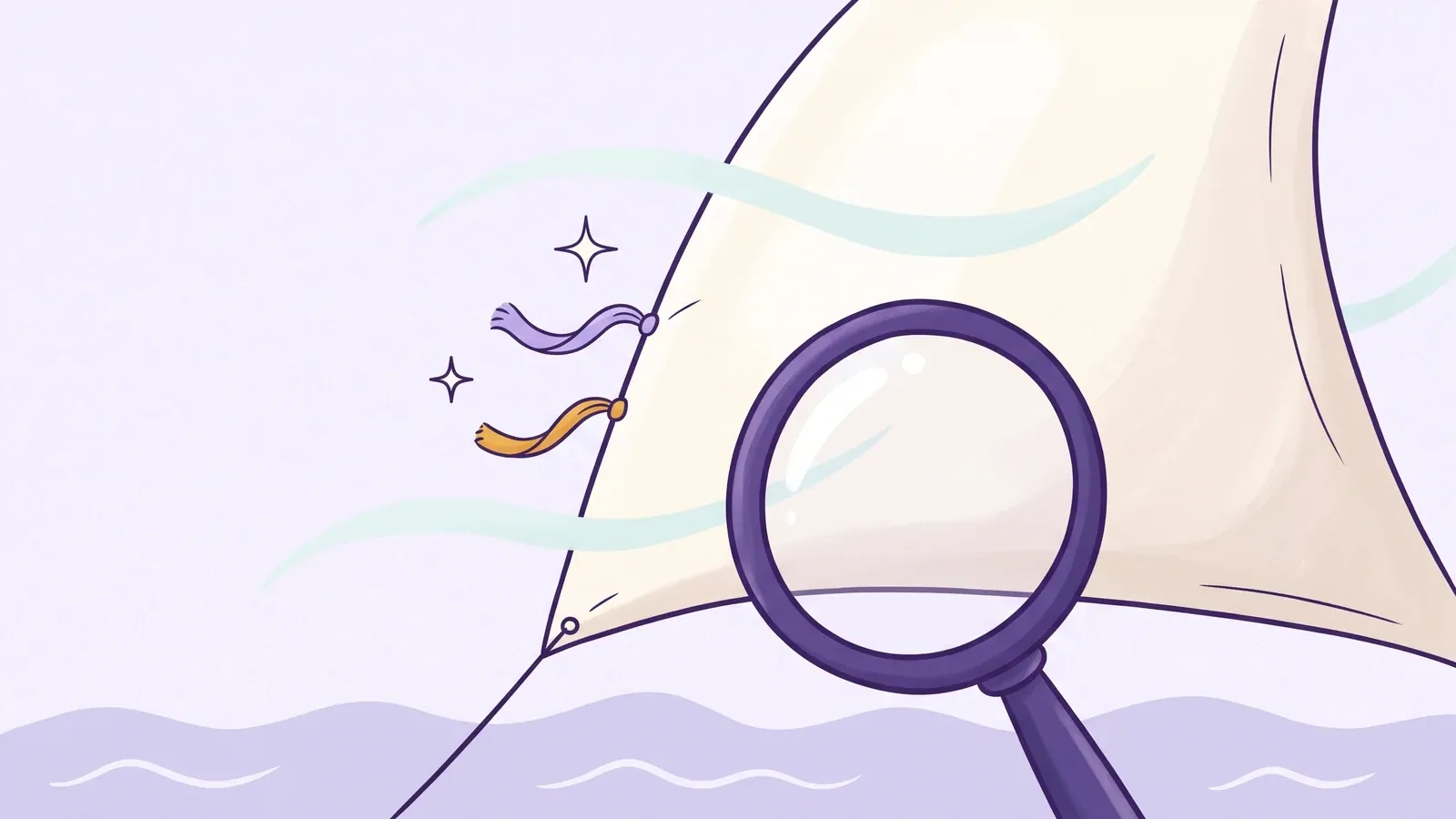
How sail telltales actually work
Telltales are airflow gauges, not magic. What attached and separated flow look like, what each telltale pattern means, when to trim and when to steer, and how leech telltales reveal twist — with an interactive trainer.
10 min read
Sailing skills
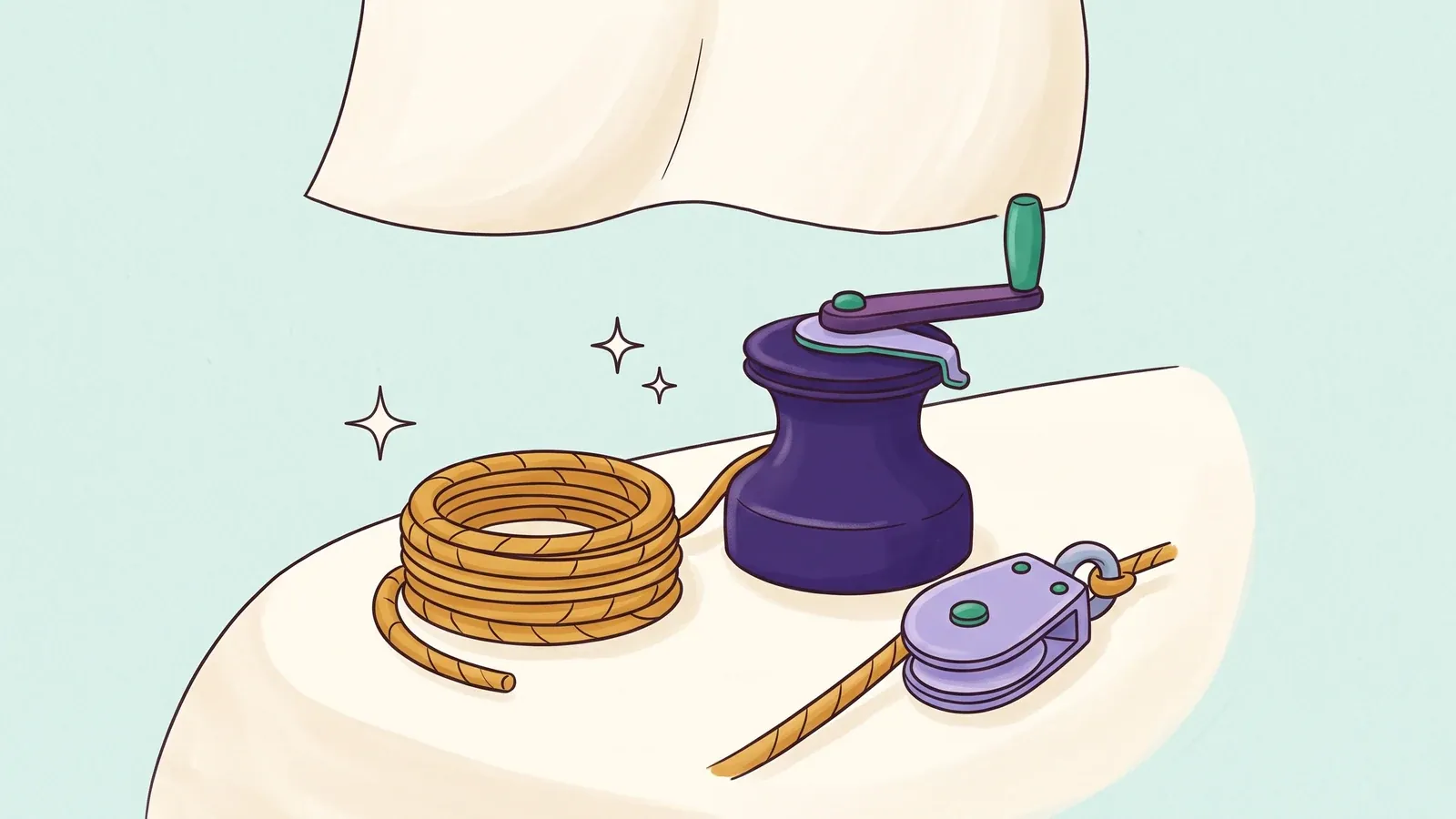
Sail trim for beginners: what every control actually does
Sheet, traveller, vang, outhaul, halyard and Cunningham, jib cars and backstay — what you move, what changes in the sail, what the boat feels like, and when you would use each. Fundamentals first, racing detail later.
11 min read

Sailing skills
When should you reef? Reading the boat instead of a number
There is no universal reef-at-X-knots rule, and no training body publishes one. What overpowered actually looks and feels like, why sailors reef early, the usual order of sail reductions, and how rig and crew change the answer.
9 min read

Seamanship
Docking a sailboat: wind, momentum and prop walk
The physics that decide every docking: momentum and steerage, windage, the pivot point, prop wash and prop walk — then planned approaches for wind on, wind off and crosswind, leaving with a spring, and when to bail out and go around.
12 min read

Seamanship
Anchoring for beginners: scope, setting and swinging
How to choose an anchorage, work out scope from depth, tide and bow height (and why the official ratios differ), set the anchor and prove it is holding, and think in swinging circles — with worked examples.
11 min read

Navigation
How to read a nautical chart
The title block, scale, latitude and longitude scales, soundings and drying heights, depth contours, seabed types, hazards, buoys, light descriptions and the compass rose — using a labelled educational chart extract.
10 min read

COLREGs
COLREGs: a repeatable method for solving any encounter
Eight questions, asked in the same order every time — in sight? overtaking? what are they? which rule? who keeps clear? what must the stand-on vessel do? is there risk? what action is enough? — applied to five worked scenarios.
11 min read

COLREGs
Who gives way? COLREG Rules 12–18 explained for sailors
Sail vs sail, power vs power, overtaking, head-on and crossing: what COLREG Rules 12–18 actually require of the give-way and stand-on vessel, with diagrams and a reasoning sequence you can use in the exam and at sea.
12 min read

COLREGs
COLREG Rules 5–8: look-out, safe speed, risk of collision and avoiding action
The four rules that apply in every condition of visibility and before any steering rule: what a proper look-out is, what decides a safe speed, how the rules define risk of collision, and what counts as action to avoid collision.
9 min read

COLREGs
Navigation lights: how to identify a vessel at night
Masthead, sidelights and sternlight and their arcs, then the extra lights that tell you a vessel is fishing, towing, anchored, not under command or restricted — with diagrams for each and the rules they come from.
12 min read

COLREGs
Rule 19 and fog signals: what changes when you cannot see the other vessel
When Rule 19 applies to vessels not in sight in or near restricted visibility, safe speed, radar-only contacts and Rule 35 fog signals explained.
9 min read
COLREGs
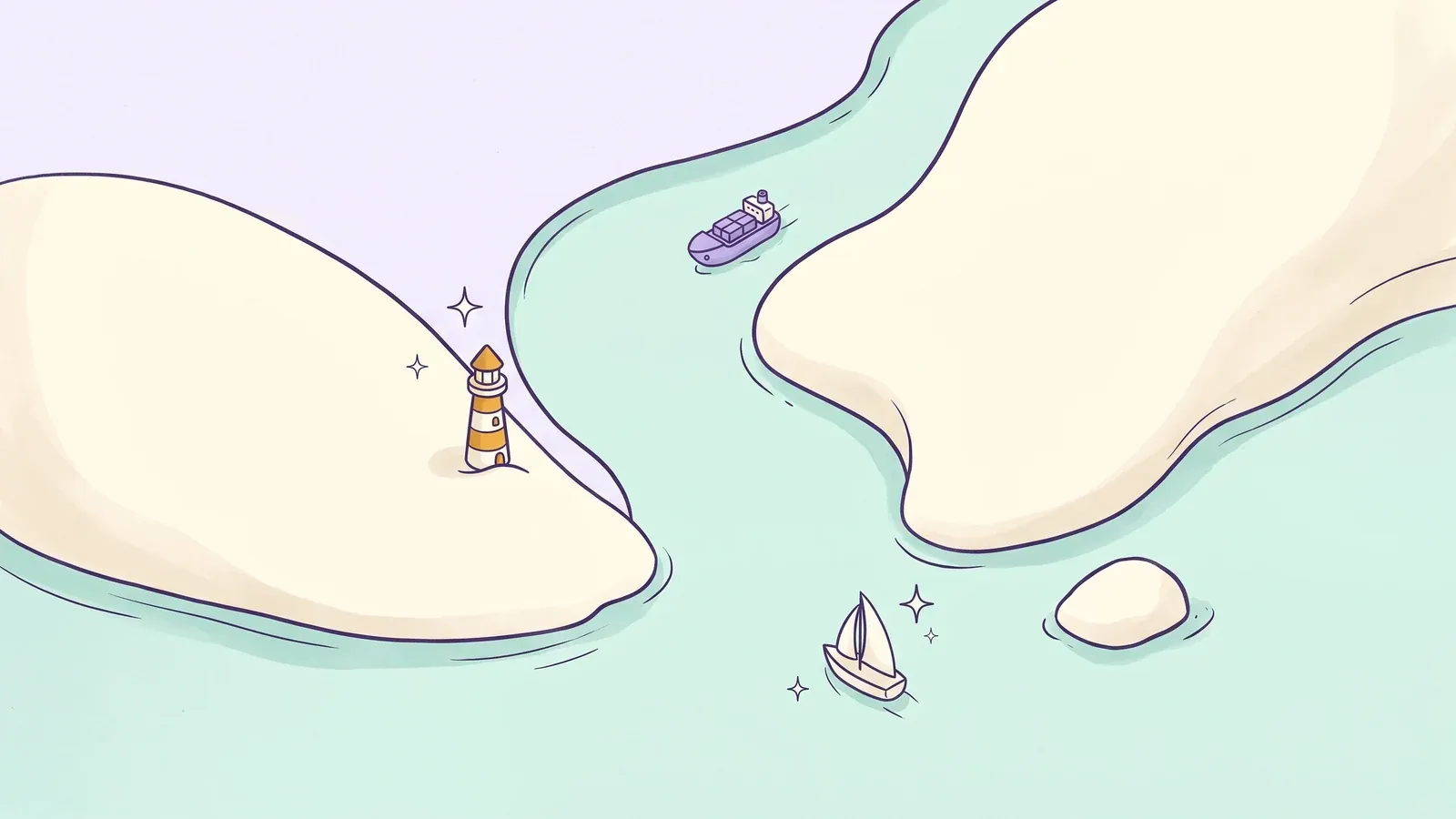
Narrow channels and traffic separation schemes: COLREG Rules 9 and 10 for small craft
What Rules 9 and 10 require of a yacht or small vessel in a narrow channel or a traffic separation scheme: keep to starboard, do not impede, cross at right angles, use the inshore zone — and what “not impede” means alongside the steering rules.
9 min read

Navigation
IALA Region A vs Region B buoyage: which side is the red buoy on?
Red to port or red right returning? How the two IALA buoyage regions differ, what “direction of buoyage” really means, preferred-channel marks, and the marks that are identical everywhere — with a side-by-side diagram.
9 min read

Navigation
Cardinal marks: how to remember topmarks, colours and lights
North, east, south, west cardinal buoys explained — what the two cones mean, why the black bands follow the cones, the clock-face trick for the light rhythms, and how to use them without shaving the danger.
6 min read

Navigation
Pilotage: how to plan and execute an entry into an unfamiliar harbour
The difference between navigation and pilotage, what goes into a pilotage plan — marks, transits, clearing bearings, depths, tides and the point of no return — and how to run the plan from the cockpit without a chart table.
8 min read

Navigation
Position fixing with bearings and transits
How to fix your position from compass bearings of charted objects, why a transit is the best position line you can get, what a cocked hat means, how to use a depth contour or a range as a position line, and how to cross-check GPS.
8 min read
Navigation
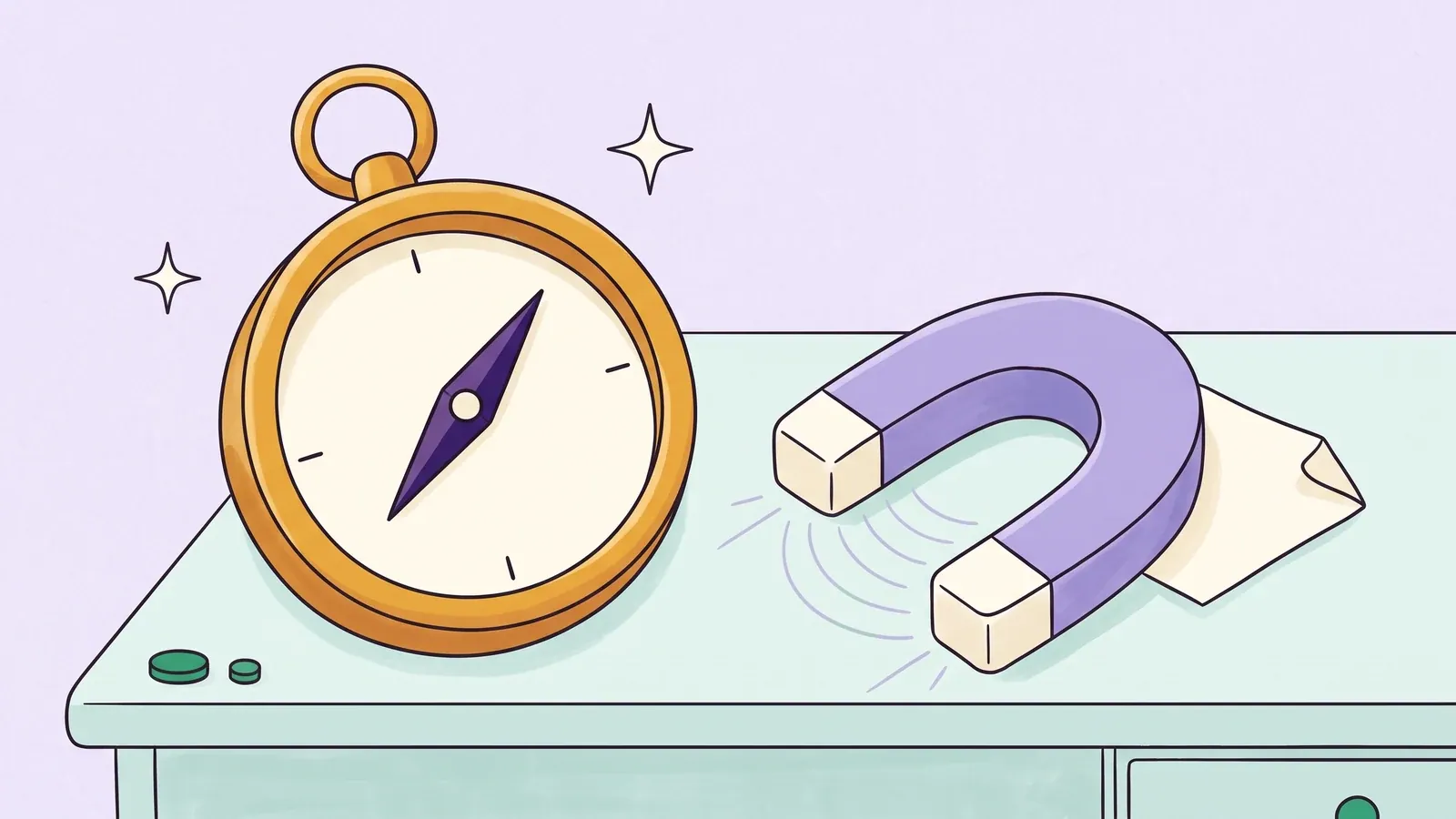
Variation and deviation: converting between true, magnetic and compass
What variation and deviation are, where each comes from, how to read variation from the compass rose and deviation from the card, and a conversion method you can apply the same way every time — with worked examples.
7 min read

Navigation
Latitude, longitude and measuring distance on a nautical chart
How positions are written and plotted, why one minute of latitude is one nautical mile, why you never measure distance on the longitude scale, and how to use dividers and a plotter on a Mercator chart.
6 min read

Navigation
Course to steer vs estimated position: the two tidal triangles
The two chartwork constructions that use a tidal stream vector — the estimated position (where am I?) and the course to steer (where should I point?) — why they are drawn in different orders, how leeway fits in, and a worked example of each.
9 min read

Tides
Chart datum, drying heights and depths: the numbers on the chart and what they measure
What chart datum is, how charted depths, drying heights, heights of tide and clearance heights are measured from it, the datums used on UK and US charts, and how to combine them without mixing quantities.
8 min read

Tides
The rule of twelfths: estimating the height of tide in your head
How the rule of twelfths approximates the tidal curve, a worked example checked step by step, what it assumes, why it says nothing about tidal streams, and when you must use the tidal curve instead.
8 min read

Tides
Tidal streams vs tidal heights: two different things, two different tools
Why height of tide and tidal stream are separate quantities, where the timing of slack water and maximum stream comes from, how to read tidal diamonds and a tidal stream atlas, and how springs and neaps change the answer.
8 min read

Exam preparation
The Day Skipper theory course and exam: what it covers and how to prepare
What the RYA Day Skipper Theory (shorebased) course covers, how it differs from the practical course, what the RYA says about the exam, the topics that need practice rather than reading, a COLREG reasoning method, and a four-week study plan.
11 min read
Knots
Six knots every sailor should know (and when to use each)
Figure-eight, reef knot, clove hitch, round turn and two half hitches, cleat hitch and bowline — the six knots in the ASA 101 basic keelboat standard, what each is for, why it holds, how it fails, plus the sheet bend as a bonus.
9 min read
Reading is the first pass. Questions are the second.
Every guide here maps to a module in the SailQuiz app — 2,800+ exam-style questions with explanations, and review that brings back what you miss.