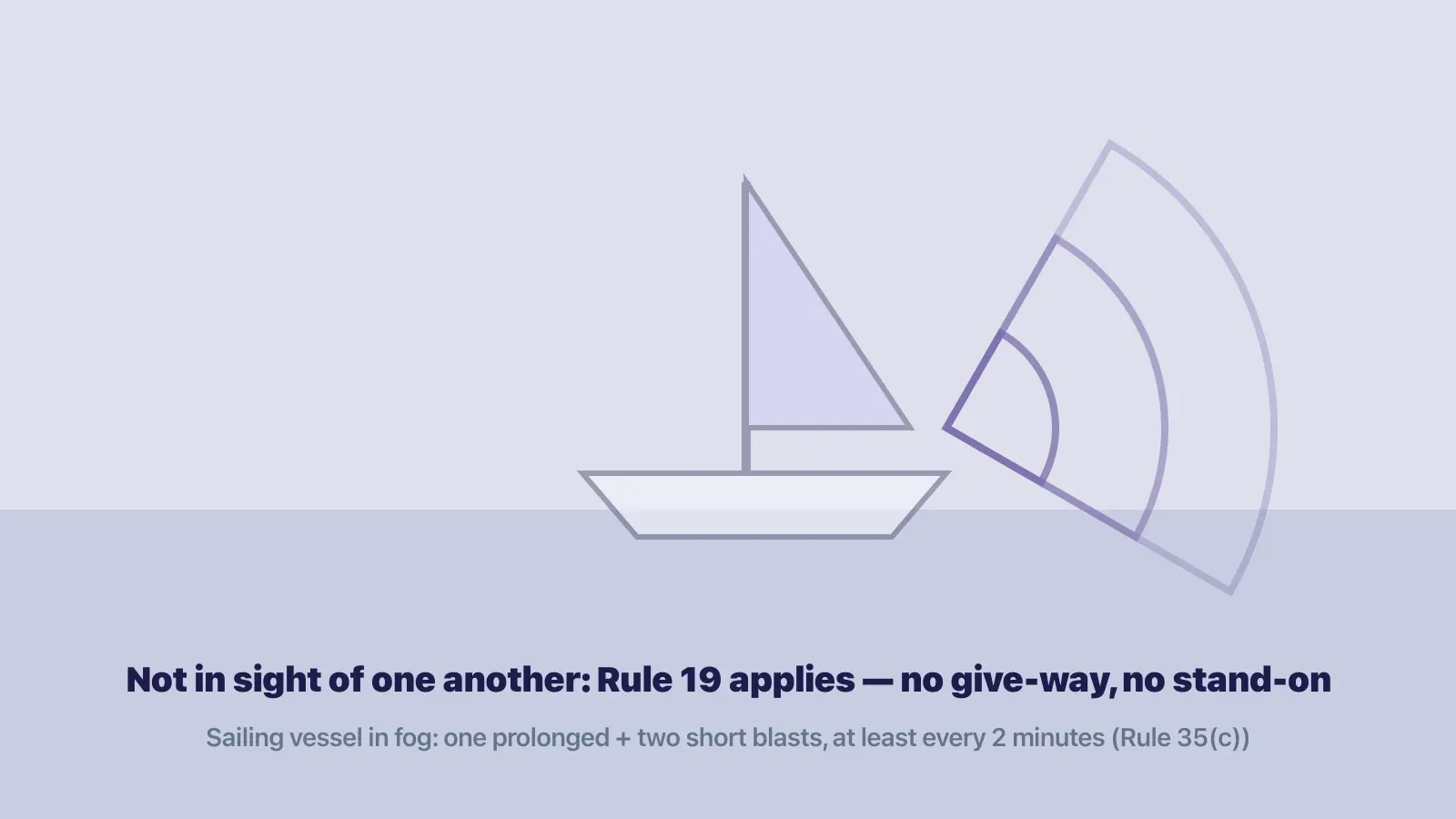
Part B has three sections: Rules 4–10 apply in any visibility; Rules 11–18 apply to vessels in sight of one another; Rule 19 applies to vessels not in sight of one another when navigating in or near restricted visibility. Both conditions matter. Darkness or distance alone does not establish restricted visibility. Keep a proper lookout and assess collision risk throughout.
Rule 19 — conduct in restricted visibility
- 19(a): the rule applies to vessels not in sight of one another when navigating in or near an area of restricted visibility. “Near” matters — a vessel in clear air just outside a fog bank is covered.
- 19(b): every vessel proceeds at a safe speed adapted to the prevailing circumstances and conditions of restricted visibility, and a power-driven vessel has her engines ready for immediate manoeuvre.
- 19(c): every vessel has due regard to the conditions of restricted visibility when complying with Rules 4–10 (Section I): look-out, safe speed, risk of collision, action, channels and TSSs.
- 19(d): a vessel which detects by radar alone the presence of another vessel shall determine if a close-quarters situation is developing and/or risk of collision exists, and if so take avoiding action in ample time. When that action is an alteration of course, she shall so far as possible avoid: (i) an alteration to port for a vessel forward of the beam, other than for a vessel being overtaken; (ii) an alteration towards a vessel abeam or abaft the beam.
- 19(e): except where it has been determined that risk of collision does not exist, every vessel which hears apparently forward of her beam the fog signal of another vessel, or which cannot avoid a close-quarters situation with another vessel forward of her beam, shall reduce her speed to the minimum at which she can be kept on her course, if necessary take all her way off, and in any event navigate with extreme caution until the danger of collision is over.
The two prohibitions in 19(d) have a logic. Avoid turning to port for a vessel ahead because, if she is doing the same thing you are, you both turn to starboard and open the distance; one turning to port would close it. Avoid turning towards a vessel abeam or abaft the beam because, if she is overtaking you, you would be turning into her path. Neither is absolute — “so far as possible” — but both are the default, and exam questions test whether you know which way not to turn.
Without radar, the radar-only provisions of 19(d) do not apply, but 19(b), (c) and (e) still do. A power-driven vessel must have engines ready for immediate manoeuvre. Unless you have determined that collision risk does not exist, a fog signal apparently forward of the beam requires reduction to the minimum speed at which you can keep course, taking all way off if necessary. Arrange an effective lookout from a safe position; AIS is an aid, not a complete traffic picture.
Sound signals in restricted visibility — Rule 35
Rule 32 defines the sounds: a short blast is about one second; a prolonged blast is four to six seconds. Rule 35 sets out the signals, all to be used in or near an area of restricted visibility, by day or night:
| Vessel | Signal | Interval |
|---|---|---|
| Power-driven vessel making way through the water | One prolonged blast | Not more than 2 minutes |
| Power-driven vessel underway but stopped and making no way | Two prolonged blasts about 2 seconds apart | Not more than 2 minutes |
| Sailing vessel; not under command; restricted in ability to manoeuvre; constrained by draught (International); engaged in fishing; towing or pushing | One prolonged followed by two short blasts | Not more than 2 minutes |
| Last vessel of a tow, if manned | One prolonged followed by three short blasts, immediately after the towing vessel's signal when practicable | Not more than 2 minutes |
| Vessel at anchor | Rapid ringing of the bell for about 5 seconds; vessels of 100 m or more add a gong aft. May add one short, one prolonged, one short blast to warn an approaching vessel | Not more than 1 minute |
| Vessel aground | The anchor bell (and gong) signal, plus three separate and distinct strokes on the bell immediately before and after the rapid ringing. May add an appropriate whistle signal | Not more than 1 minute |
| Pilot vessel on pilotage duty | May add an identity signal of four short blasts | — |
| Vessel 12 m to under 20 m | Not obliged to give the bell signals at anchor or aground, but must then make some other efficient sound signal | Not more than 2 minutes |
| Vessel under 12 m | Not obliged to give any of the above, but must then make some other efficient sound signal | Not more than 2 minutes |
Two things to notice. First, a sailing vessel and a power-driven vessel stopped and drifting make different signals, so what you hear tells you something about what is out there. Second, the small-craft exemptions do not exempt you from making a signal — a yacht under 12 m still has to make an efficient sound signal at least every two minutes; she simply has latitude in what it is. In practice, use the prescribed signal for your vessel: it is what the ship's bridge team is listening for.
The common mistake
Do not assume “we are sailing, so the ship must give way” when you are not in sight of one another in or near restricted visibility. Rule 19 applies to both vessels. Nor is AIS alone a reason to maintain speed: not every vessel transmits, and the displayed data may be incomplete or stale.
Check yourselfMotoring in fog with radar, you detect a contact fine on the starboard bow, range closing, bearing steady. Which rule applies, what may you not do, and what should you do?Show answer
Rule 19(d), because you have detected the vessel by radar alone and are not in sight of one another — not Rule 15, which needs vessels in sight. Risk of collision exists (steady bearing, closing range, Rule 7). Take avoiding action in ample time, and since the contact is forward of the beam and you are not overtaking her, avoid an alteration to port. A substantial alteration to starboard, and/or a reduction in speed, is the default; sound your fog signal, keep the engine ready, and keep plotting her until she is past and clear.
Key takeaways
- Not in sight, and in or near restricted visibility: Rule 19 applies. In sight: use Rules 11–18, with due regard to the conditions.
- Safe speed for the visibility, engines ready, and all available means for detection.
- With a radar-only contact: act early; avoid altering to port for a vessel ahead (unless overtaking her) and avoid turning towards a vessel abeam or abaft the beam.
- Fog signal apparently forward of the beam: unless no collision risk has been established, reduce to minimum course-keeping speed, take all way off if necessary, and navigate with extreme caution.
- Sound signals: one prolonged for power making way; two prolonged for power stopped; one prolonged and two short for sail and the hampered categories; bell at anchor; bell with three strokes before and after when aground. Every two minutes, one minute for bell signals.