

Skip to content

In the SailQuiz app · 21 modules · 1,000+ questions

Day Skipper Theory, Actually Explained

Quiz-based Day Skipper learning for sailors who want to understand chartwork, tides, pilotage, weather, lights, buoyage, and COLREGS without drowning in jargon. The deepest course in SailQuiz.

Download on the App StoreGet it on Google Play

Free to download · No account needed · Works offline

Your practice companion

A little structure for your study.

Pick a module, take a short quiz, then read the explanations and review the questions you missed.

Quiz scores help you choose what to study next. They do not certify competence or predict an exam result.

Start with one free quiz and three Daily Challenge rounds a day. More about the app.

Download on the App StoreGet it on Google Play
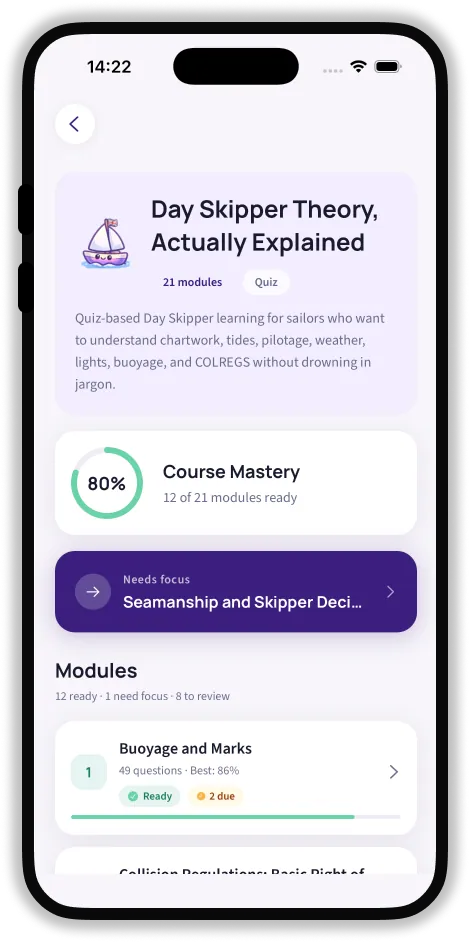
Real Day Skipper course screen showing modules and progress
Day Skipper module progress · Open App Store ↗

What's inside

  1. Buoyage and Marks
  2. Collision Regulations: Basic Right of Way
  3. Navigation Lights and Shapes
  4. Compass Basics and Headings
  5. Charts and Chart Symbols
  6. Latitude, Longitude, and Position Fixing
  7. Tides: Core Concepts
  8. Tidal Heights and Drying Heights
  9. Tidal Streams and Tidal Planning
  10. Course to Steer and Leeway Basics
  11. Pilotage and Harbour Entry Planning
  12. Passage Planning Fundamentals
  13. Weather Basics for Day Skipper
  14. Anchoring
  15. Ropes, Warps, and Essential Knots
  16. Engine Checks and Basic Engine Awareness
  17. Emergency Procedures and Distress Situations
  18. Man Overboard Recovery Awareness
  19. Rules of the Road: Practical Scenarios
  20. Night Sailing Awareness
  21. Seamanship and Skipper Decision-Making

Who it's for

Sailors studying RYA Day Skipper-level theory, refreshing COLREGS and navigation, or preparing to skipper a boat on coastal passages and charters.

Supplementary practice on Day Skipper-level topics: International COLREGs, IALA Region A buoyage and tidal chartwork in metres. This is not an RYA course or a verified full-syllabus replacement.

Topics covered

  • COLREGS
  • Lights & shapes
  • IALA buoyage
  • Tides & tidal streams
  • Charts & position fixing
  • Pilotage
  • Passage planning
  • Anchoring
  • Man overboard
  • Night sailing

How you'll study

  • Exam-style quizzes with a clear explanation for every question
  • Smart review that resurfaces what you get wrong
  • Module progress to help you choose what to practise next
  • Fully offline — study anywhere, no account needed

Sample practice questions

Try these before you download. Pick an answer, then reveal the explanation — every one of the 1,000+ questions in the app is explained the same way.

Two power-driven vessels in sight of one another are crossing in open water with risk of collision. The other is on your starboard side. Under International Rule 15, what must you do?

  1. A.Stand on — starboard side has priority
  2. B.Keep out of her way, and avoid crossing ahead if possible
  3. C.Turn to port and speed up
  4. D.Sound one short blast and hold course
Reveal answer and explanation

Answer: B. Keep out of her way, and avoid crossing ahead if possible

Rule 15: the vessel which has the other on her own starboard side is the give-way vessel, and should avoid crossing ahead. An early, obvious alteration to starboard is the usual action.


At night you see a white light flashing quickly six times, then one long flash. What is it?

  1. A.A north cardinal mark
  2. B.A south cardinal mark
  3. C.A safe water mark
  4. D.An isolated danger mark
Reveal answer and explanation

Answer: B. A south cardinal mark

Six quick (or very quick) flashes followed by a long flash mark a south cardinal — six matches 6 o'clock on the clock-face aid. Pass to the south of it.

Assuming a symmetrical six-hour rise, approximately how much of the tidal range rises during the third hour after low water under the rule of twelfths?

  1. A.1/12
  2. B.2/12
  3. C.3/12
  4. D.6/12
Reveal answer and explanation

Answer: C. 3/12

The rule of twelfths approximates the rise per hour as 1, 2, 3, 3, 2, 1 twelfths. The third and fourth hours carry the fastest change — a quarter of the range each.

Practise free on the site

Interactive quizzes and trainers on the topics this course covers — no sign-up, every answer explained.

Free guides for this course

Prefer to read first? These guides explain the same theory the course examines — free, no app needed.

Navigation

How to read a nautical chart

The title block, scale, latitude and longitude scales, soundings and drying heights, depth contours, seabed types, hazards, buoys, light descriptions and the compass rose — using a labelled educational chart extract.

10 min read

Navigation

Cardinal marks: how to remember topmarks, colours and lights

North, east, south, west cardinal buoys explained — what the two cones mean, why the black bands follow the cones, the clock-face trick for the light rhythms, and how to use them without shaving the danger.

6 min read

Navigation

Position fixing with bearings and transits

How to fix your position from compass bearings of charted objects, why a transit is the best position line you can get, what a cocked hat means, how to use a depth contour or a range as a position line, and how to cross-check GPS.

8 min read

Browse all navigation guides, tides guides and exam preparation guides.

Scope & sources

Page copy and samples checked on . SailQuiz’s questions are independently authored, not official exam questions. A complete mapping to a certifying body’s syllabus has not been established.

Study Day Skipper Theory, Actually Explained in the SailQuiz app

1,000+ questions with explanations, smart review, and offline study — free to download.

Download on the App StoreGet it on Google Play

SailQuiz is an independent study aid. It is not affiliated with, endorsed by, accredited by, or otherwise connected to the ASA, US Sailing, the RYA, the USCG, or any other certifying body, and it is not a substitute for their official training or examinations.