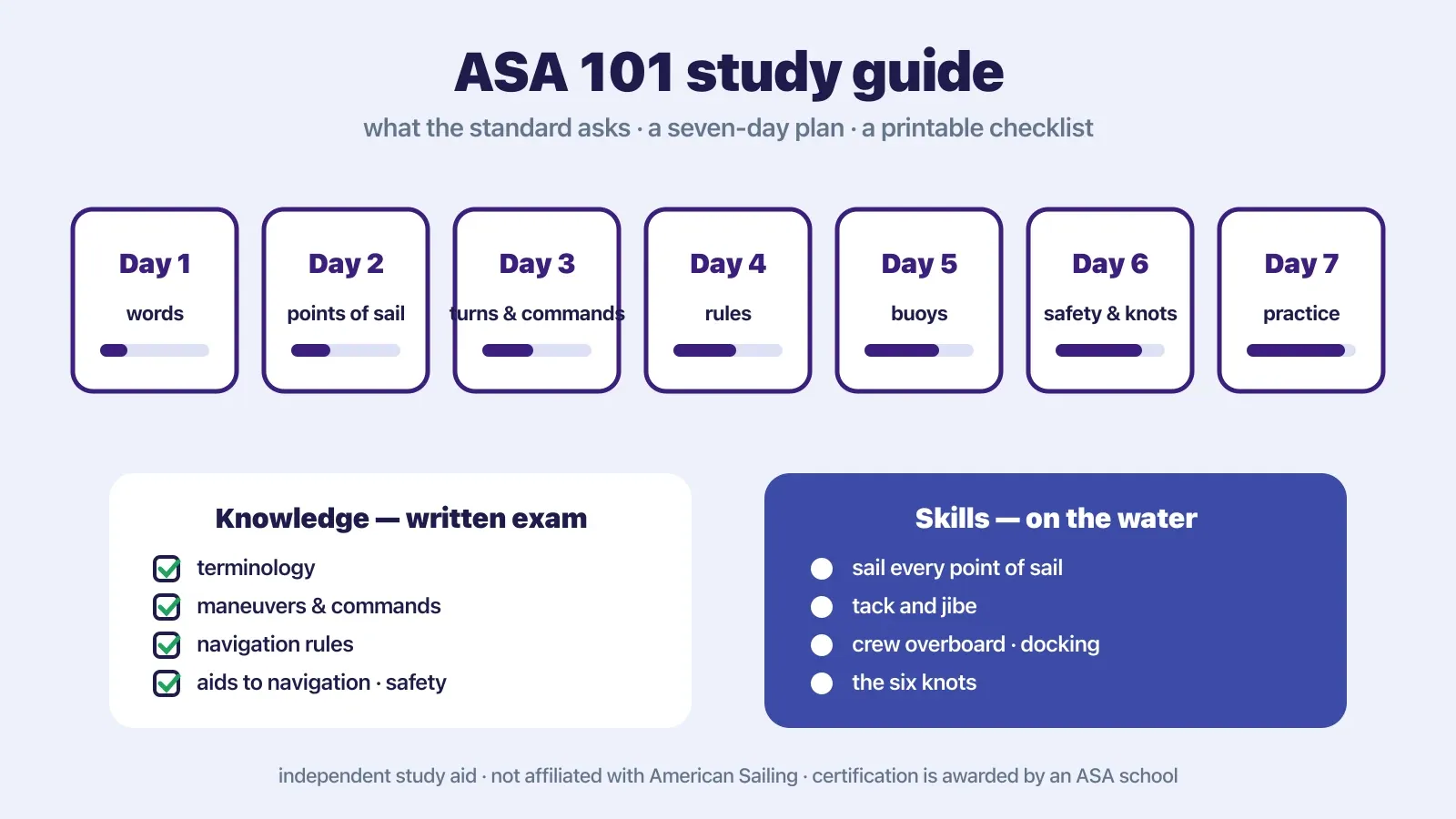
ASA 101 Keelboat Sailing 1 is the entry point to the American Sailing certification ladder. American Sailing's own description is a course for complete beginners with no prerequisites, in which you learn the language of sailing and the essential skills — hoisting sails, tacking, and navigating safely — on a small keelboat. Certification requires demonstrating the skills on the water and passing a written exam. This guide is about the second half: what the written exam can ask, what beginners typically misunderstand, and how to prepare in a week of short sessions. It is independent of American Sailing, and it does not replace the course, the textbook or your instructor.
What ASA 101 is, and who it is for
- Prerequisites: none. It is written for people who have never sailed.
- Format: American Sailing says most courses run over two full days, though schools vary. Some schools add an online introduction first.
- What it certifies: the ability to skipper a sloop-rigged keelboat of roughly 20 to 27 feet, in daylight, in light to moderate conditions with winds up to 15 knots.
- Study materials listed by American Sailing: the Sailing Made Easy textbook, the USCG Navigation Rules and Regulations Handbook, and A Boater's Guide to the Federal Requirements for Recreational Boats. The two government publications are free.
- Assessment: on-water skills demonstrated to your instructor, plus a written exam on the knowledge elements.
Who it suits: anyone who wants to sail small keelboats with confidence, crew usefully on a friend's boat, or start the ladder that leads to coastal cruising (ASA 103) and bareboat chartering (ASA 104). If you are choosing between schemes, note that US Sailing runs a separate Basic Keelboat certification and the RYA a separate ladder; the knowledge is largely shared, the certificates are not.
Knowledge on paper, skills on the water
The published ASA 101 standard separates twenty knowledge elements from twenty skills elements. The distinction tells you how to spend your preparation time.
| Knowledge (written exam) | Skills (assessed on the water) |
|---|---|
| Terminology: boat parts, sails and sail controls, directions and sailing terms | Use of a life jacket; trimming with the halyards, sheets, outhaul, vang and traveler |
| Maneuvers and points of sail, and the helm commands with crew responses | Leaving and returning to a dock or mooring under sail or power |
| Navigation Rules for a 25-foot sailing vessel; stand-on and give-way; commercial traffic and the danger signal | Holding a tack and course; getting out of irons; heading up and bearing away; sailing each point of sail |
| Aids to navigation: lateral, preferred channel, safe water, special and information/regulatory marks | Tacking and jibing as helm, and giving the crew responses as crew |
| Safety: federally required equipment, navigation lights, float plan, accident reporting, the federal BAC limit | Crew overboard under sail; lowering, furling and stowing sails; securing the boat; tying the six knots |
Topic checklist from the current standard
The headings below follow the knowledge sections of the ASA 101 standard, paraphrased. Each links to the free SailQuiz explanation or trainer that covers it. Tick the topics off in the printable version further down.
1. Basic sailing terminology
Identify the parts of the boat and their functions (hull, deck, transom, keel, rudder, mast, boom, gooseneck, standing rigging with shrouds, spreaders and stays, stanchions and lifelines, winches, cleats, fairleads, fenders and dock lines); the sails, their corners and edges, and the sail controls (halyards, sheets, outhaul, vang, traveler, Cunningham, topping lift, telltales); and the directional and descriptive terms (port, starboard, forward, aft, abeam, windward, leeward, draft, freeboard, heel, weather helm, reefing, lift and drag). Start with our sailing terms every beginner should know, and sail trim basics: what each control does.
2. Maneuvers and points of sail
Using diagrams, explain head-to-wind, the no-sail zone, close-hauled, close reach, beam reach, broad reach, run, sailing by the lee, wing-on-wing, in irons, luffing, port and starboard tack, tacking and jibing, stand-on and give-way; and use the helm commands “Heading up”, “Bearing away”, “Ready to tack” — “Ready” — “Hard alee” and “Ready to jibe” — “Ready” — “Jibe ho”. Practise with the points of sail trainer, points of sail and apparent wind guide, and tacking vs jibing guide.
3. Navigation Rules
For a 25-foot recreational sailing vessel, using the USCG Navigation Rules: the responsibility to keep a look-out; sailing vessels with the wind on different sides and on the same side; overtaking, for sail and power; power-driven vessels head-on and crossing; a sailing vessel crossing a power-driven vessel; and what to do near commercial traffic, including how to respond to the danger signal. Identify the stand-on and give-way vessel in each case. Read who gives way? Rules 12 to 18, a method for any encounter, look-out, safe speed and collision risk (Rules 5 to 8), and narrow channels and traffic separation.
4. Aids to navigation
The purpose of lateral aids, including preferred channel marks, and how to identify them by color, shape and numbering; and how to identify safe water, special purpose, and information and regulatory marks. In US waters the lateral system is IALA Region B: red to starboard when returning from sea. Compare regions with the IALA Region A vs B trainer, and IALA buoyage guide.
5. Safety gear and procedures
List the federally required equipment for a 25-foot recreational sailboat; state where the navigation lights of a 25-foot vessel are carried and their colors; describe the purpose and contents of a float plan and who it goes to; describe when and to whom boating accidents must be reported; and state the federal blood alcohol content limit for operating a vessel. These come straight from the two free USCG publications listed in the sources — read the equipment table for boats 16 to less than 26 feet, the navigation-lights section for sailing vessels under 20 metres, and the accident-reporting page. Our navigation lights guide covers the sailing-vessel light options; the rest is best read in the USCG guide itself, because the exact requirements are what the exam wants.
6. The six knots
The knots element sits with the skills: describe the purpose of, and tie without assistance, the figure-eight, reef (square) knot, clove hitch, round turn and two half hitches, cleat hitch and bowline. Read what each is for, and how each fails, in six knots every sailor should know.
Common beginner misunderstandings
These are the ideas that most often come out wrong in beginner quizzes and on first days afloat. Each one is a specific, checkable fact.
A seven-day preparation plan
Day 1 — The boat and the words
- Read the sailing terms guide once, then label a photo or sketch of a sloop from memory: hull, keel, rudder, mast, boom, forestay, backstay, shrouds, spreaders, lifelines, winches, cleats.
- Learn the sail vocabulary as pairs: head–tack–clew (corners), luff–leech–foot (edges), halyard–sheet (raise vs trim).
- Five minutes of the terminology quiz in the guide. Note anything you got wrong for day 7.
Day 2 — Points of sail and the wind
- Ten minutes on the points of sail trainer until you can name the point of sail and the tack from the wind arrow alone.
- Read the points of sail and apparent wind guide. Be able to draw the diagram with the no-sail zone.
- Say out loud, for each point of sail: where the wind is, how far the sails are eased, and which side the boom is on for each tack.
Day 3 — Maneuvers and commands
- Read the tacking vs jibing guide. Draw both sequences with the wind from the top of the page.
- Memorise the two command exchanges and what the crew does at each step.
- Learn the definitions the standard names: head-to-wind, in irons, luffing, by the lee, wing-on-wing, heading up, bearing away.
Day 4 — Navigation Rules
- Read who gives way (Rules 12 to 18) and the method guide. Work each of the standard's seven situations: look-out; sail vs sail on different tacks; same tack; overtaking; power head-on; power crossing; sail crossing power.
- For each, say who is stand-on, who is give-way, and what each must do (Rules 16 and 17).
- Read the danger signal (five or more short blasts) and the commercial-traffic advice in the narrow channels guide.
Day 5 — Aids to navigation
- Use the Region A vs B trainer and read the US section of the buoyage guide: color, shape (nun and can), numbering, preferred channel marks, safe water, special and information/regulatory marks.
- From the USCG Aids to Navigation booklet, sketch each mark type from memory.
Day 6 — Safety, equipment and knots
- From the USCG federal requirements guide: list the required equipment for a boat of 16 to less than 26 feet, the sailing-vessel light configurations, what a float plan contains and who gets it, when accidents must be reported and to whom, and the federal BAC limit.
- With a metre of rope, tie the six knots and say what each is for. If you cannot yet tie one, learn it from a video or your instructor — the guide explains the why, not the how.
Day 7 — Practice and review
- Take the free ASA 101 practice test. Read every explanation, including the ones you got right.
- Go back to your day 1 to 6 notes and re-test only the things you got wrong.
- Write down three questions for your instructor. Arriving with questions is the best sign of preparation.
Printable checklist
ASA 101 knowledge checklist
The knowledge elements of the standard, paraphrased, plus the six knots. Print it, tick it off, and bring the gaps to your instructor.
Terminology
Maneuvers and points of sail
Navigation Rules
Aids to navigation
Safety gear and procedures
Knots (purpose, and tie without help)
What to prepare for the on-water half
- You will be asked to sail every point of sail, tack and jibe as helm, respond correctly as crew, get out of irons, and recover a person overboard under sail. Knowing the commands and the sequence in advance means the instructor's words land the first time.
- Bring the knots in your hands, not just in your head: the standard says tie them without assistance, in a timely manner.
- Read our first-lesson guide for what to wear, what to bring, and the safety habits you will be told about on day one.
Key takeaways
- ASA 101 has no prerequisites, is usually taught over two full days, and certifies you to skipper a 20 to 27 foot keelboat in daylight and winds up to 15 knots.
- The standard splits twenty knowledge elements (the written exam) from twenty skills elements (assessed on the water). Prepare the knowledge before the course.
- The knowledge checklist is short: terminology, maneuvers and commands, seven Navigation Rules situations, US aids to navigation, federal safety requirements, and the purpose of six knots.
- The mistakes to avoid: naming the tack from the boom, believing sail always has right of way, applying red-right-returning outside Region B, joining ropes with a reef knot.
- The seven-day plan is a study structure. Certification comes from the school, after the course, the exam and the on-water assessment.