Rules 9 and 10 sit in Section I of the steering and sailing rules, which means they apply in any visibility. They also appear by name at the top of Rule 18 — “except where Rules 9, 10 and 13 otherwise require” — which is why a yacht cannot rely on being a sailing vessel in a channel or a traffic separation scheme. This guide covers what each rule asks of a small vessel, the sound signals that go with them, and the difference between “not impede” and “keep out of the way”.
Rule 9 — narrow channels
- 9(a): a vessel proceeding along a narrow channel or fairway keeps as near to the outer limit on her starboard side as is safe and practicable. Keep right.
- 9(b): a vessel under 20 m or a sailing vessel shall not impede the passage of a vessel which can safely navigate only within the channel or fairway.
- 9(c): a vessel engaged in fishing shall not impede the passage of any other vessel navigating within the channel.
- 9(d): a vessel shall not cross a narrow channel if the crossing impedes the passage of a vessel which can safely navigate only within it. The latter vessel may use the doubt signal of Rule 34(d) — five or more short blasts — if in doubt about the crossing vessel's intention.
- 9(e): overtaking in a narrow channel where the overtaken vessel has to take action to permit safe passing is done by signal and agreement (Rule 34(c)), and does not relieve the overtaking vessel of her Rule 13 duty.
- 9(f): a vessel nearing a bend where other vessels may be obscured navigates with particular alertness and caution and sounds one prolonged blast (Rule 34(e)); an approaching vessel within hearing answers with one prolonged blast.
- 9(g): any vessel shall, if circumstances admit, avoid anchoring in a narrow channel.
The rules do not define “narrow channel”. Courts and instructors treat it as a matter of fact: a dredged channel through a shallow estuary is one for a container ship even if a yacht has plenty of water either side, and that is the point of 9(b). The ship is confined; you are not. For a yacht the practical reading is: stay out of the buoyed channel when you can, keep to its starboard edge when you cannot, cross it quickly and squarely when clear of traffic, and never tack across the bow of a ship that cannot turn.
U.S. Inland Rule 9 differs in two places worth knowing. On the Great Lakes, Western Rivers and designated waters, a power-driven vessel going downbound with a following current has the right-of-way over an upbound vessel and proposes the manner of passing (9(a)(ii)). And the Inland overtaking signals in a channel are one or two short blasts, answered with the same signal if agreed, rather than the International two-prolonged-plus-short signals.
Rule 10 — traffic separation schemes
A traffic separation scheme is a set of one-way lanes for shipping, adopted by IMO and printed on the chart, with a separation zone or line between the lanes and often an inshore traffic zone between the scheme and the coast. Rule 10 applies to vessels using a scheme and to vessels crossing or near it, and — the rule says so in its first paragraph — does not relieve any vessel of her obligations under any other rule. A ship in a lane is still bound by Rules 5 to 8 and 12 to 18.
| Paragraph | Requirement |
|---|---|
| 10(b) | A vessel using a scheme proceeds in the appropriate lane in the general direction of traffic flow, keeps clear of the separation line or zone, and joins or leaves at the end of a lane, or from the side at as small an angle as practicable. |
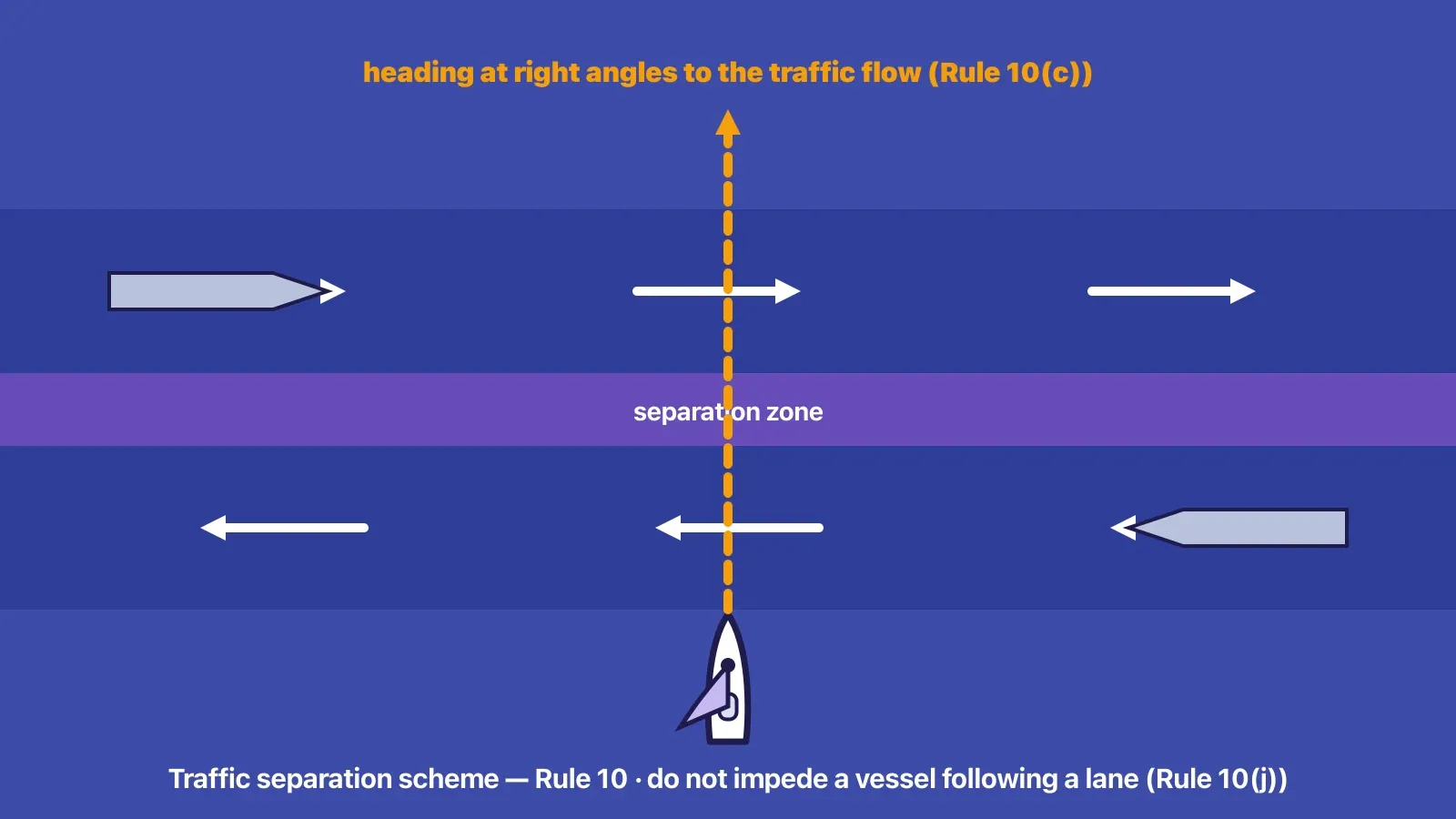
| 10(c) | Avoid crossing lanes if practicable; if obliged to cross, do so on a heading as nearly as practicable at right angles to the general direction of traffic flow. |
| 10(d) | Do not use an inshore traffic zone when you can safely use the adjacent lane — except that vessels under 20 m, sailing vessels and vessels engaged in fishing may use the inshore traffic zone, and any vessel may use it to reach a port or place within it, or to avoid immediate danger. |
| 10(e) | Do not enter a separation zone or cross a separation line except when crossing, joining or leaving, in an emergency, or to fish within the zone. |
| 10(h) | A vessel not using a scheme avoids it by as wide a margin as practicable. |
| 10(i), (j) | A vessel engaged in fishing shall not impede the passage of any vessel following a lane; a vessel under 20 m or a sailing vessel shall not impede the safe passage of a power-driven vessel following a lane. |
Two points are examined constantly. First, “heading at right angles”, not track: with a cross-tide your track will be skewed, and the rule is deliberately about heading, because a heading square to the lane shows other vessels — and their radar — the shortest, most predictable crossing. Second, the inshore traffic zone exists for small craft; a yacht coasting along a TSS should normally be inside it, not in the lanes and not in the separation zone.
“Not impede” versus “keep out of the way”
Rules 9(b) and 10(j) do not say the yacht is the give-way vessel. They say she must not impede — and Rule 8(f) explains what that means. She must take early action, when the circumstances require, to leave sufficient sea room for the other vessel's safe passage. If she has not done that and risk of collision develops, she remains bound by the not-impede duty and must also act with full regard to the steering rules. And the ship whose passage is not to be impeded remains fully obliged to comply with the steering rules if risk of collision arises. In plain terms: get out of the way early enough that the steering rules never come into play; if they do, both vessels must follow them, and the yacht must still not impede.
So a sailing yacht in a TSS lane with a ship approaching from astern is being overtaken (Rule 13), and the ship keeps clear — but the yacht should never have let it get to that point, because Rule 10(j) told her to keep out of the ship's way well before. A yacht crossing a lane with a ship approaching on her port side is, under Rule 18, the stand-on vessel — but Rule 10(j) still obliges her to have crossed early enough not to impede, which in practice means altering or waiting so that the ship never has to think about her.
The sound signals that go with these rules
- One prolonged blast (4–6 seconds): approaching a bend or an obscured stretch of channel (Rule 34(e)); answered with one prolonged blast.
- Five or more short and rapid blasts: I do not understand your intentions, or I doubt you are taking sufficient action to avoid collision (Rule 34(d)). A ship in a channel may sound this at a yacht that looks like crossing ahead. It is not an insult; it is a request to act.
- International overtaking in a narrow channel: two prolonged followed by one short (I intend to overtake on your starboard side) or two short (on your port side); agreement is prolonged–short–prolonged–short (Rule 34(c)). Inland: one or two short blasts, answered in kind.
- Manoeuvring signals by power-driven vessels in sight of one another (Rule 34(a)): International — one short blast, I am altering course to starboard; two, to port; three, operating astern propulsion. Inland uses the same blasts with a different meaning: one short blast means I intend to leave you on my port side, two means on my starboard side, and the other vessel answers in agreement.
Check yourselfYou are sailing along the edge of a buoyed channel in an estuary. A coaster is coming up the channel astern of you, and a ferry is about to cross ahead. Which rules apply to you and what do they require?Show answer
Rule 9(b): as a sailing vessel you shall not impede the coaster if she can safely navigate only within the channel — get out of the channel or well to its starboard edge early, before she is close. Rule 13 makes her the overtaking vessel if she comes up from astern, but your 9(b) duty applies first and earlier. The ferry crossing ahead is a separate Rule 18 encounter unless she too is confined to the channel; and Rule 9(a) tells you to keep as near the starboard side of the channel as is safe if you must be in it. Keep a look-out astern (Rule 5).
Key takeaways
- In a narrow channel keep to the starboard side; vessels under 20 m and sailing vessels must not impede a vessel that can only navigate inside it.
- In a TSS, follow the lane direction, avoid the separation zone, cross with your heading at right angles, and use the inshore traffic zone if you are a small or sailing vessel.
- “Not impede” is an early duty to leave sea room (Rule 8(f)). It does not switch off the steering rules if risk of collision develops — both vessels must then comply, and you must still not impede.
- Rules 9, 10 and 13 are the exceptions named at the head of Rule 18: they come before the sail-over-power ranking.