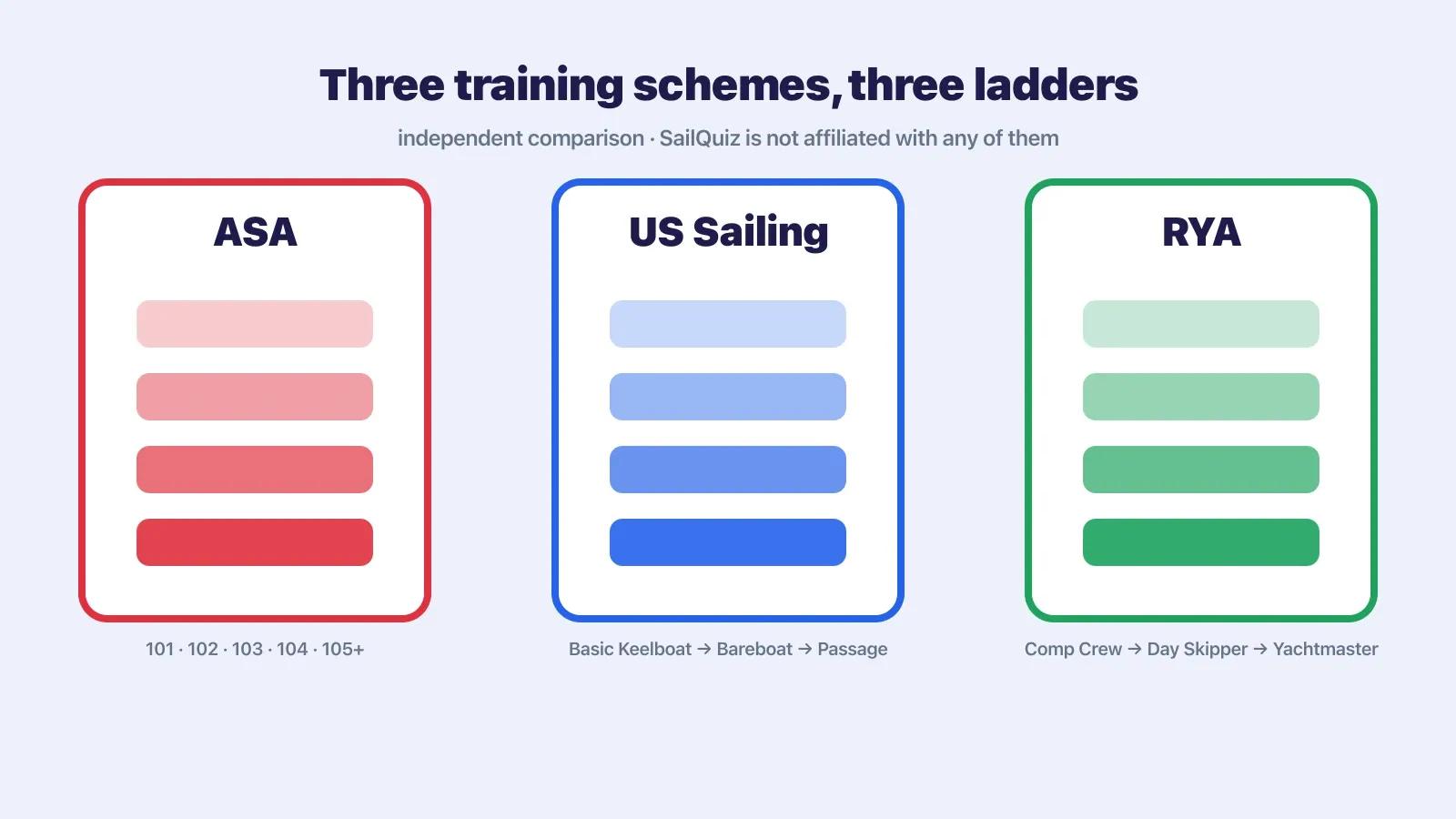
If you search this question you will find confident, contradictory answers. This guide instead reports what each organisation says about its own scheme on its official pages, checked on 31 August 2026, and then untangles the licence and charter questions that usually motivate the search. SailQuiz is independent and not affiliated with the ASA, US Sailing or the RYA.
Three ladders
| American Sailing (ASA) | US Sailing | RYA (sail cruising) |
|---|---|---|
| 101 Keelboat Sailing 1 — no prerequisites | Basic Keelboat — no prerequisite in most cases | Start Yachting (2 days) / Competent Crew (5 days) — no experience needed |
| 102 Keelboat Sailing 2 | Performance Sailing | Day Skipper Theory (shorebased, 40 h + exam) |
| 103 Coastal Cruising | Basic Cruising — requires Basic Keelboat | Day Skipper Practical — requires sea time and theory to shorebased level |
| 104 Bareboat Cruising | Bareboat Cruising — requires Basic Cruising | Coastal Skipper / Yachtmaster Offshore Theory |
| 105 Coastal Navigation | Coastal Navigation — no prerequisite | Coastal Skipper Practical |
| 106 Advanced Coastal Cruising; 107 Celestial; 108 Offshore Passagemaking; 114 Cruising Catamaran; endorsements 116–120 | Coastal Passage Making; Celestial Navigation; Offshore Passage Making; Catamaran endorsement | Yachtmaster Coastal / Offshore / Ocean — Certificates of Competence by exam |
American Sailing (ASA)
ASA is a U.S.-based organisation with affiliated schools, strongest in the United States and the Caribbean. Its standards are course-based: each certification “requires participants to fully satisfy both knowledge and skills standards, which will be verified through a written exam and an on-the-water practical exam”, recorded in the ASA logbook. ASA 101 has no prerequisites. The public ASA standards documents list exactly what each level examines, which makes them useful study targets even if you train elsewhere.
US Sailing
US Sailing is the national governing body for the sport in the United States. Its Keelboat Certification System runs from Basic Keelboat (skipper a tiller-steered keelboat up to about 27 feet in familiar waters in light to moderate conditions) through Basic Cruising and Bareboat Cruising to Coastal Passage Making and Offshore Passage Making, each with the previous level as prerequisite; Coastal Navigation and Celestial Navigation sit alongside. Assessment is by knowledge and skill requirements set for each level.
RYA
The Royal Yachting Association's scheme is British in origin and delivered by recognised training centres worldwide. It separates theory (shorebased courses such as Day Skipper Theory, with an invigilated exam) from practical courses (Competent Crew, Day Skipper, Coastal Skipper), and its top qualifications — Yachtmaster Coastal, Offshore and Ocean — are Certificates of Competence gained by an examination conducted independently of the training centre, not by completing a course. Day Skipper Practical requires prior sea time (5 days, 100 miles, 4 night hours) and theory knowledge to shorebased level.
The differences that matter to a learner
- Geography and availability. ASA and US Sailing schools are concentrated in North America and the Caribbean; RYA centres are worldwide, including the Mediterranean, Asia and Australia. Where you live usually decides.
- Theory versus practical. The RYA formally splits the two and expects theory before the skipper practical; ASA and US Sailing embed theory in each course with a written test. If you enjoy studying, the RYA shorebased route rewards it; SailQuiz's Day Skipper Theory course is built around that syllabus.
- Assessment style. ASA and US Sailing certify on completing a course's standards; RYA practical courses issue course-completion certificates, while Yachtmaster is a stand-alone exam with an external examiner.
- Cruising orientation. All three lead to bareboat-level qualifications (ASA 104, US Sailing Bareboat Cruising, RYA Day Skipper/Coastal Skipper). Which one a charter company prefers depends on the company and the country — see below.
- Buoyage and rules. U.S.-taught courses use IALA Region B and the U.S. Inland Rules alongside the International rules; RYA courses use Region A and the International rules. If you learn in one system and charter in the other, revise the differences.
“Do I need a licence?” — four separate questions
The reason this question produces contradictory answers is that it is four questions. Separate them and the answers become checkable.
- Legal requirement of the country whose waters you are in. The RYA states there is “no legal requirement to hold a licence to skipper a vessel in UK waters” (the VHF operator's licence is a separate legal requirement). In the U.S., requirements are set by states, mostly as boater-education cards keyed to age and powered craft; NASBLA maintains the table. Many European countries do require evidence of competence, and the requirement can differ between coastal and inland waters.
- Charter-company requirement. Companies set their own rules, often stricter than the law, and the RYA's advice is to get the required evidence of competence from the charter provider in writing before booking, and to check it covers the cruising area, the local legislation and the company's insurance.
- Insurance requirement. Your own or the charter company's insurer may require a specific certificate or logged experience regardless of the law.
- Flag state. A charter boat abroad is usually flagged in the country you charter in, so that country's rules for its own vessels apply to you, not your home country's.
The ICC
The International Certificate for Operators of Pleasure Craft (ICC, historically “International Certificate of Competence”) was developed under UNECE Resolution No. 40. The UK government has accepted the resolution and authorises the RYA to issue the UK ICC. The RYA describes it as “an assurance from one government to another that the certificate holder is sufficiently competent”, valid for five years, available from age 16, and issued on the basis of an eligible RYA certificate or a separate ICC assessment. Two RYA cautions are worth quoting: the ICC “should be automatically accepted in countries which have adopted Resolution No. 40”, but only a handful of the 56 UNECE countries have fully adopted it; and “the ICC is not the boating equivalent of the EU driving licence”. The RYA nonetheless recommends carrying it for inland European waterways and Mediterranean coastal waters, noting that Spain, Greece and Portugal have not adopted the resolution but are still likely to ask for it. The RYA will only issue an ICC to nationals of Resolution-40 countries if they are UK residents.
The IPC
ASA and US Sailing each issue an International Proficiency Certificate (IPC) through their own eligibility process. An IPC is not an ICC. Do not infer that U.S. nationality prevents someone obtaining an ICC: issuing-authority eligibility can depend on nationality and residence, as well as competence. Check the RYA’s current eligibility guidance or the relevant issuing authority, and get the charter operator’s document requirements in writing before booking.
Choosing
- If you live in North America and want to cruise or charter in the U.S. and Caribbean: ASA or US Sailing, whichever has a good school near you. Look at the instructor and the boats, not the logo.
- If you live in the UK, Europe or somewhere with RYA centres, or you want the structured theory route: the RYA scheme.
- If you plan to charter in the Mediterranean: ask the charter company what they accept before you choose a course. An RYA Day Skipper leading to an ICC, or an ASA/US Sailing bareboat level leading to an IPC, are the usual routes.
- If you are undecided: any first-level course will teach you to sail. The scheme matters most at bareboat level, and you can cross over later — sea time counts in all of them.
Check yourselfYou hold ASA 101 and 103 and want to bareboat-charter in Croatia next summer. What do you need to find out, and from whom?Show answer
From the charter company, in writing: what evidence of competence they require for that boat in Croatian waters, and whether an ASA IPC (which requires 104 as well) or another document will satisfy both them and the local authorities. Croatia is listed by the RYA as requiring evidence of competence (“essential”), and ASA lists Croatia among countries accepting its IPC — but the company's insurer and the boat's size may impose more. Do not rely on a forum post that says “they never check”.
Key takeaways
- ASA and US Sailing are U.S. course-based schemes; the RYA separates theory from practical and awards Yachtmaster by exam.
- None is universally “recognised”. The ICC (UNECE Res. 40) is the standard document in Europe; ASA and US Sailing issue IPCs because the U.S. is outside Res. 40.
- “Do I need a licence?” splits into law, charter company, insurer and flag state. Answer each separately and get the charter company's answer in writing.
- Choose by where you live, where you will sail, and the quality of the school — then sail a lot.