Sailing looks like a closed world from the outside: jargon, expensive boats, people who seem to have been doing it since childhood. From the inside it is a set of skills that anyone can learn in an ordered way. This roadmap separates what you can learn on your sofa from what needs a boat, describes the ways people actually get on the water, and sets out a realistic progression from first lesson to being able to take a boat out yourself.
What you can learn ashore, and what you cannot
Theory transfers well from books, courses and apps: the words, the points of sail, why a sail works, the collision regulations, buoyage, charts, tides, weather, knots and the language of a crew briefing. Learning these first makes lessons cheaper, because your instructor's time goes into sailing rather than vocabulary.
What does not transfer is feel: the pressure in the helm, when a sail is about to luff, how much the boat carries her way, what a gust does before it arrives, and how it feels to be mildly frightened and still do the right thing. Nobody becomes competent at helming, docking, reefing or recovering a person from the water by reading. A theory course, including this site, is preparation for time on the water, not a substitute for it.
| Learn ashore first | Needs a boat and an instructor |
|---|---|
| Boat parts, directions, points of sail, tacking vs gybing | Steering to the wind and to the telltales |
| Why sails produce lift; apparent wind | Trimming by feel; reefing under way |
| COLREGs, lights, shapes, sound signals | Judging distance, speed and risk on the water |
| Charts, buoyage, tides, compass, position fixing | Pilotage into a real harbour with real traffic |
| Weather and forecasts | Deciding to stay in port, and living with the decision |
| Knots, radio procedure, safety equipment | Docking, anchoring, man-overboard recovery |
The ways people actually get on the water
- A sailing school beginner course. The standard route: two to five days on a school boat with an instructor, in a group of three to five. RYA Start Yachting (two days) and Competent Crew (five days) need no experience; ASA 101 and US Sailing Basic Keelboat have no prerequisites either.
- A sailing or yacht club. Many run adult beginner training at a fraction of commercial prices, own club boats, and have a noticeboard or crew list where members ask for crew. Membership is usually cheaper than one week of chartering.
- Crewing. Racing boats need crew every week and will teach you in exchange for turning up; cruising owners often want company on passages. Crew-finder websites, club noticeboards and simply walking the pontoons on a race evening all work. Be honest about your experience and reliable about showing up.
- Dinghy sailing. Dinghy clubs and centres teach on small, responsive boats that show you the wind immediately. It is the fastest way to learn what the wind is doing and the cheapest way to sail regularly.
- Flotilla and charter holidays. A flotilla puts you on your own boat with a lead boat nearby; many companies take couples with a basic certificate and some experience. A skippered charter lets you learn by watching before you are responsible.
Dinghy or keelboat?
Most training dinghies rely on crew movement for balance and can capsize; learn capsize recovery with suitable clothing, buoyancy and supervision. Keelboats generally use ballast for stability, but are not immune to capsize or swamping, and some small keelboats have no engine or cabin. Both can be good learning boats. Choose an appropriate school, boat and conditions for your goals, confidence and mobility.
A realistic progression
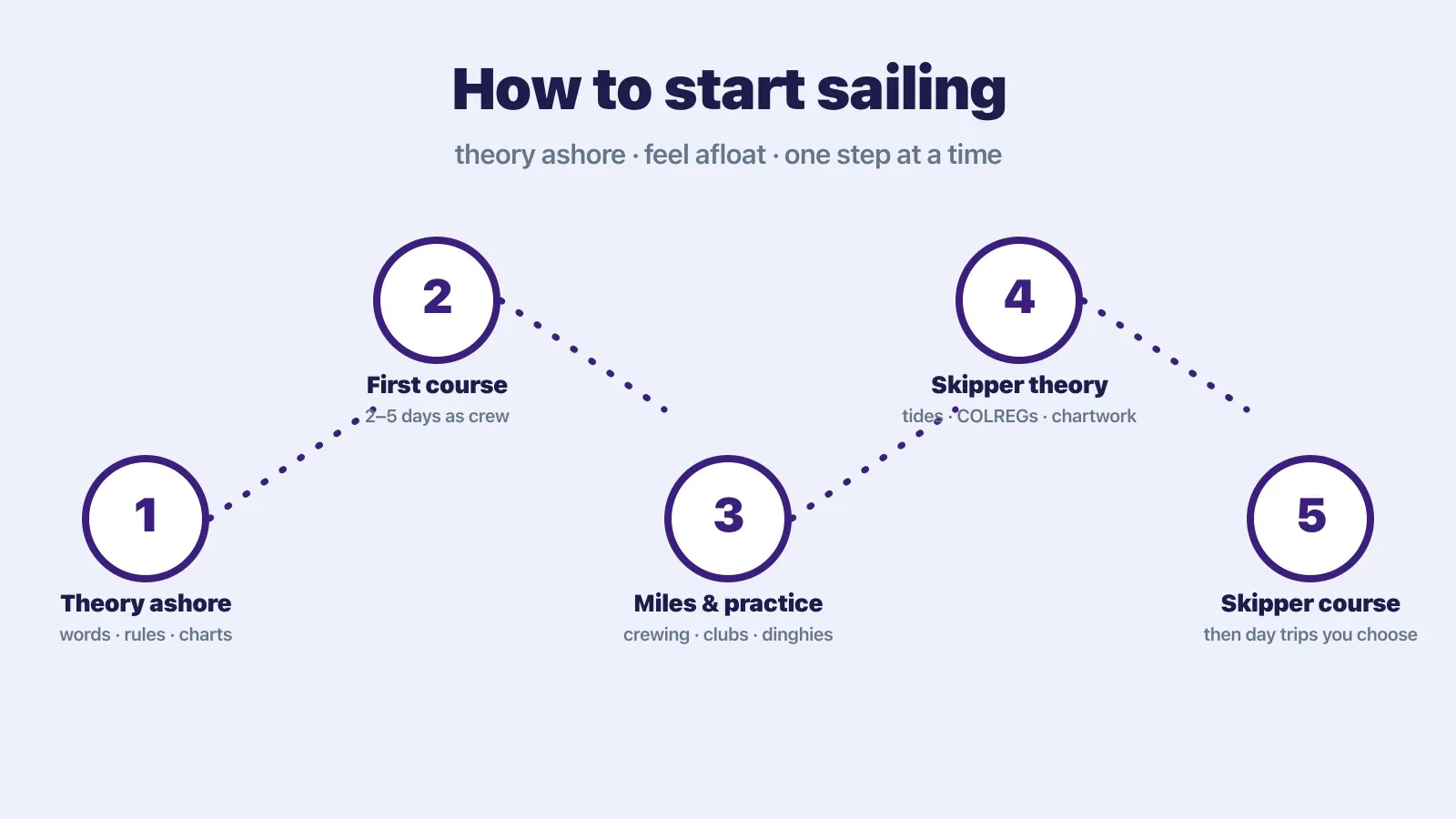
- Before the first lesson: learn the vocabulary and the points of sail, and tie a bowline and a figure-eight. Our first-lesson guide covers exactly this. Two evenings is enough.
- First course (2–5 days): become useful crew. You should come away able to steer a course, tack and gybe on command, handle sheets and halyards, tie the basic knots, and know what the skipper means. The RYA describes Competent Crew graduates as able to steer, handle sails, keep a lookout and assist in day-to-day routines; ASA 101 and US Sailing Basic Keelboat aim at skippering a small keelboat in light to moderate conditions in familiar waters.
- Miles and repetition (a season or two): sail as often as you can with people who are better than you. Practise the same manoeuvres until you stop thinking about them. Start doing the navigation on other people's boats.
- Theory to skipper level: a Day Skipper Theory course or equivalent — chartwork, tides, COLREGs, weather, passage planning. This is where SailQuiz's Day Skipper Theory course sits.
- Skipper course and assessment: RYA Day Skipper Practical (which requires prior sea time and theory to shorebased level), ASA 103/104 or US Sailing Basic/Bareboat Cruising. These are the courses that charter companies and the ICC scheme look at.
- Skippering by day in familiar waters with a crew you trust, in weather you have chosen. Then longer passages, night sailing, and unfamiliar harbours — each one deliberately, one new variable at a time.
Practising between lessons
- Knots with a length of rope, until you can tie them behind your back.
- Points of sail and apparent wind with our interactive explorer, then watch boats from the shore and name what they are doing.
- Lights and buoyage in the app: five minutes a day beats an hour a week.
- Read the forecast every morning for your local water and guess what it will feel like; check against what you see.
- Walk the marina at low water and look at what dries. Tides become real when you can see the mud.
Check yourselfYou have done a five-day beginner course and hold the certificate. A friend asks you to skipper their 36-foot yacht across a busy channel next weekend. What is the honest answer?Show answer
Not yet — and not because of the certificate. First-level courses are explicitly about familiar waters, by day, in light-to-moderate conditions, as crew or as skipper of a small keelboat. A cross-channel passage on an unfamiliar larger boat involves passage planning, tides, traffic, night sailing and crew management you have not practised. Go as crew, do the navigation under supervision, and build towards it.
Key takeaways
- Learn the language and theory ashore; learn feel and manoeuvres afloat. Both are needed, in that order.
- You do not need a boat: schools, clubs, crewing, dinghies and flotillas all get you sailing.
- Dinghy for feel, keelboat for cruising skills; either is a good start.
- Progress deliberately: crew → miles → skipper theory → skipper course → skippering in conditions you choose.
- Certificates record training. Competence comes from sea time.